

It has been almost 12 weeks since I began estradiol patches for metastatic prostate cancer. Originally diagnosed in 2018 with locally advanced high-risk disease, I attempted conventional androgen deprivation therapy with goserelin (Zoladex) injections after a radical prostatectomy, but stopped it after two injections in the summer of 2018 due to severe side effects.
I have avoided ADT since then and underwent radiation to my pelvis in the fall of 2018 and proton therapy to my para-aortic lymph nodes in early 2023. My PSA has steadily climbed since the pelvic radiation, reaching 762 ng/mL on June 5, 2026.
My PSA and testosterone on estradiol patches
Since starting estradiol patches 0.1 mg, four patches twice weekly, on July 12, 2026, my PSA and testosterone levels have dropped dramatically:
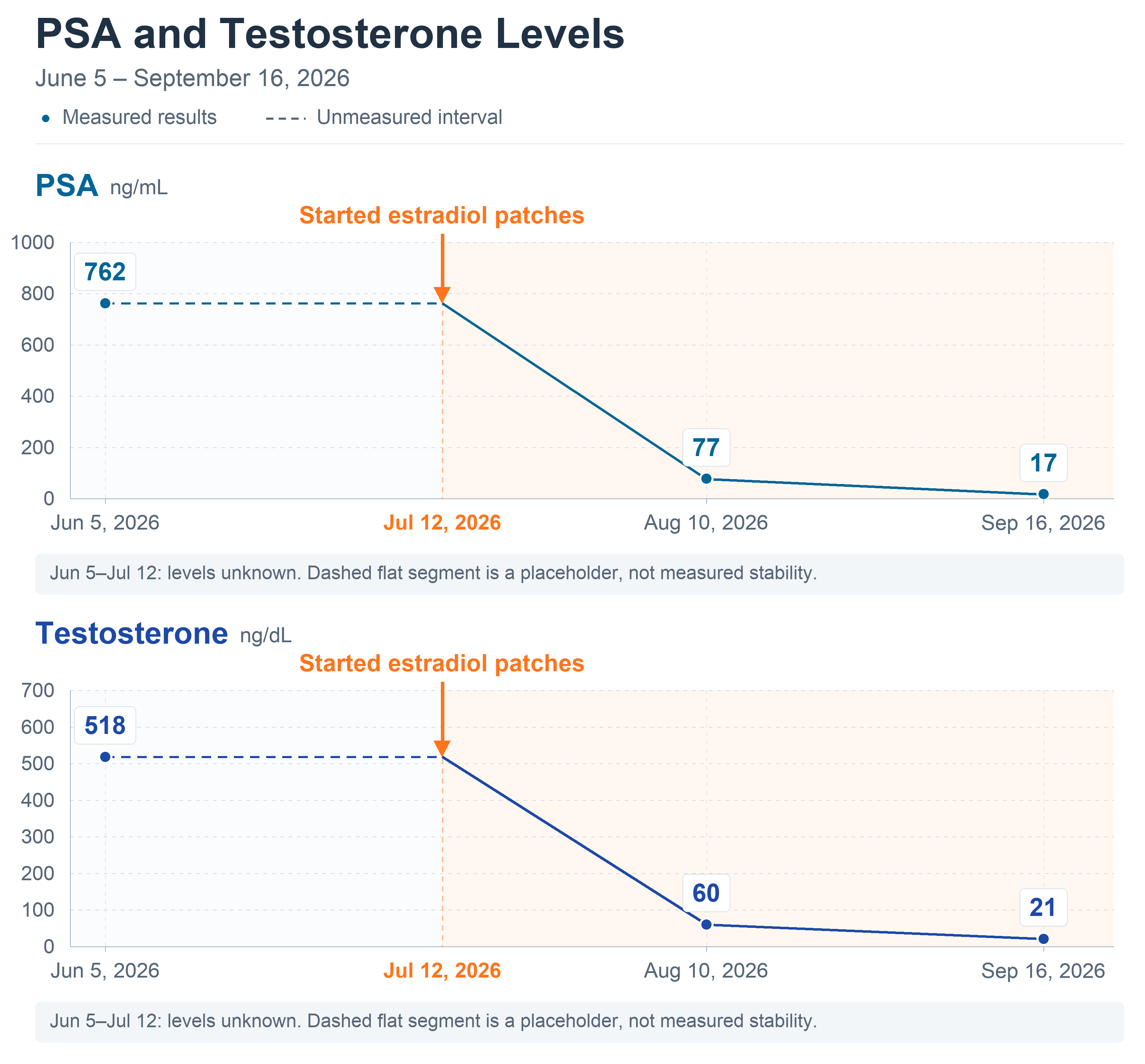
My PSA might actually have been higher than 762 ng/mL on the day I started the patches, since there was a 5-week period between when that blood level was drawn and when I actually started the patches.
As you can see from the graph, my PSA isn't undetectable yet, but hopefully, it is headed there. My current testosterone level is considered castrate, though not yet below 20 ng/dL. Some experts prefer less than 20, based on studies suggesting men who reach that level may do better, but definitive evidence is still pending.
The PATCH trial results I discussed in my last post included men treated with estradiol patch monotherapy and had locally advanced disease that had not spread beyond the pelvis.
The PATCH program still has pending trial results for men with metastatic disease treated with estradiol patches as their ADT. Hopefully, those results will be out in the next one to two years. The strongest published survival evidence for transdermal estradiol patches in prostate cancer still comes from men whose disease is less advanced than mine.
Estradiol levels on patches
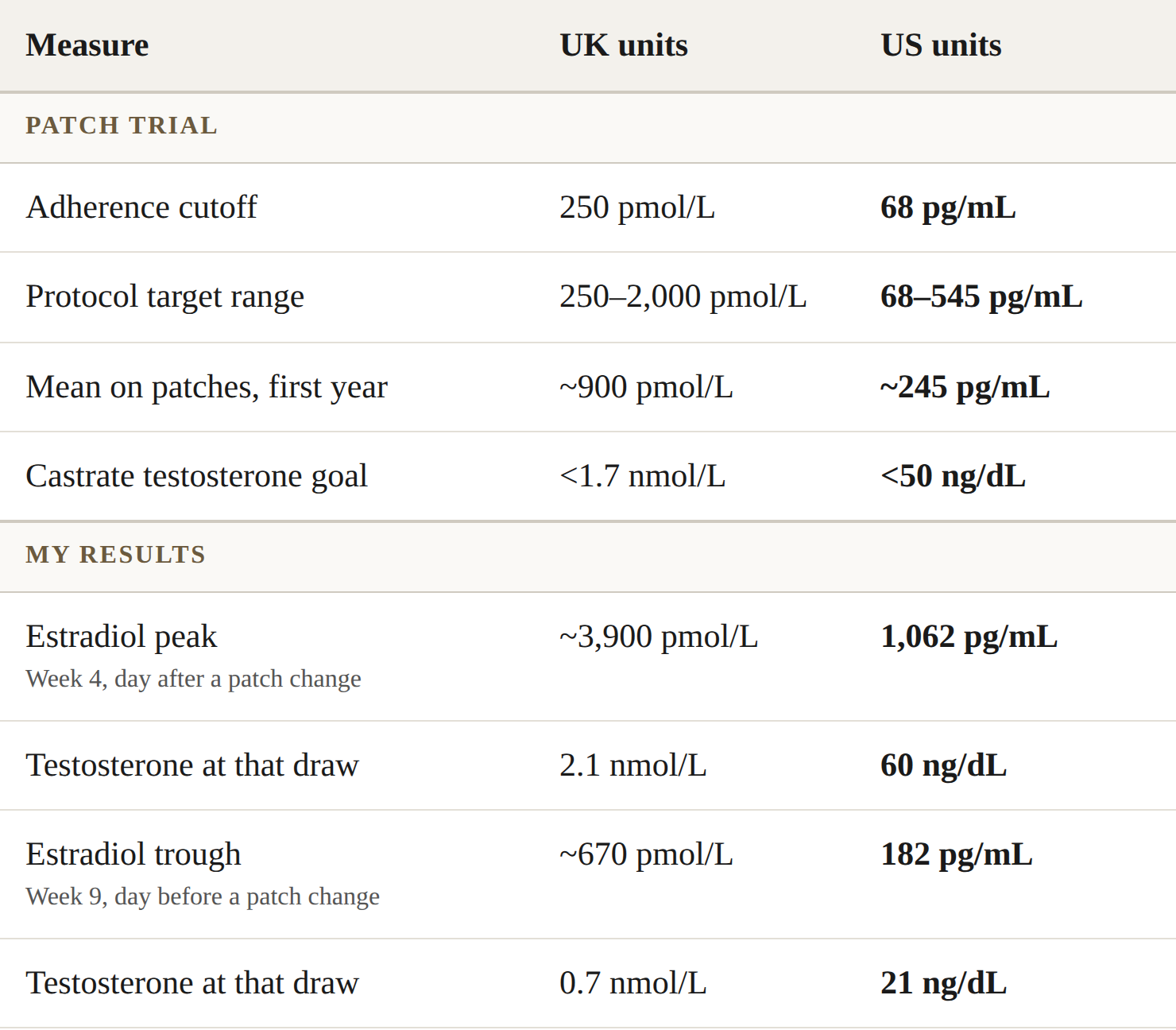
Investigators in the PATCH M0 trial defined men as non-adherent using an estradiol level below 68 pg/mL, reflecting patch detachment, missed patch changes, or poor dermal absorption.
Investigators aimed for an acceptable estradiol range of 68-545 pg/mL. During the first year of the study, the average estradiol level in men was roughly 245 pg/mL, with most men on a maintenance dose of three patches changed twice weekly.
Four weeks after starting the patches, the morning after I changed my patches, my estradiol was 1,062 pg/mL. That was likely near my peak because I had recently changed the patches. On September 16, I had blood drawn on the last day before a patch change, near my lowest (trough) point, which was 182 pg/mL.
Keep in mind that I'm also still on four patches changed twice weekly, while most men on patches in the recently published PATCH study had dropped to three patches for maintenance, which may explain why my peak level runs higher than what was reported in the trial.
I am also using generic patches that stick well despite showers, baths, swims, and occasional hot tub use.
What I call my trough, or lowest level, is well within the PATCH target range of about 68 to 545 pg/mL, but my high point is about twice the top of that target range.
Does my high peak level really matter? The PATCH investigators found no excess heart attacks, strokes, or blood clots in men on patches compared with men on conventional ADT, in an analysis of nearly 1,700 men with and without metastases. But the trial wasn't designed to tell us whether peaks as high as mine carry extra risk
I don't think my peak estradiol level is dangerous, but I can't prove that.
The bigger question is whether my testosterone stays castrate at the bottom (trough) of the patch cycle, when my estradiol level is lowest. Thankfully, mine did. At my estradiol level trough, about nine weeks after starting the patches, my testosterone was 21 ng/dL, which is well under the classic castrate goal of less than 50.
Four weeks after starting the patches, it had been 60 ng/dL, still slightly above the PATCH trial’s castrate goal. In the trial, about 83% of men on patches reached castrate levels by one month and 92% by three months, so adequate suppression of testosterone often takes a little time to fully kick in.
If you’re on patches, ask your doctor about when they draw your blood in your patch cycle. The same patches can give very different numbers depending on the day.
Side effects and lack thereof
Overall, the patches are working much better than I thought they would, and I’m currently experiencing no side effects from them. I don’t feel as if my libido has changed, and I have had severe erectile dysfunction since the prostatectomy, which is also unchanged.
I did undergo 3 days in a row of prophylactic radiation therapy to both breast buds to help avoid gynecomastia, which is common in men on estradiol patches. My radiation oncologist chose a dose of 5 Gy each day, for a total of 15 Gy.
I initially had mild skin erythema, itching, and mild nipple tenderness from the irradiation, but these problems have resolved. I’m no longer using topical Voltaren (diclofenac sodium 1%) gel to manage the tenderness.
I have experienced absolutely no hot flashes, night sweats, interrupted sleep, or mood changes since starting the patches. Although my last checked testosterone was 21 ng/dL, I haven't experienced loss of muscle strength at the gym or noticed any obvious muscle loss.
Granted, I started this estradiol regimen with over 40 years of regular weight training under my belt and have continued training 3-4 days per week. I usually end my gym workouts with a high-intensity five-minute stationary bike ride.
I also usually walk a mile at a brisk pace on the days I don’t weight train. Research shows that resistance training, combined with aerobic exercise, improves muscle mass, strength, and physical function in men with prostate cancer being treated with ADT.
In fact, some studies show that men on ADT can not only maintain but gain muscle with appropriate resistance training, and I’m planning a future Substack post on that topic. So, keep an eye out for that.
Benefits of estradiol patches
As I reported in my last Substack post, a PATCH substudy found that men on monotherapy with estradiol patches gain bone mineral density and have better glucose and cholesterol levels than men on conventional ADT.
However, the current standard of care for men with metastatic prostate cancer is not monotherapy, but doublet or triplet therapy. Doublet therapy means ADT plus an androgen receptor pathway inhibitor (ARPI) such as abiraterone, enzalutamide, apalutamide, or darolutamide.
A small randomized study from the STAMPEDE trial, presented in 2025, compared 79 men with metastatic disease. Men on combined estradiol patches with an ARPI had similar PSA responses to men on conventional ADT plus an ARPI. The study showed that 61% in each group reached a PSA of 0.2 or lower within six months.
Triplet therapy adds chemotherapy, which I have never considered as an option for me. My preference is for quality of life over quantity of life, and that is part of the reason why I’m on monotherapy with estradiol patches.
I also want to see how far these patches, by themselves, will lower my PSA.
The future
To be honest, I’m not sure if I will add an ARPI in the future. Even if I hadn’t found estradiol patches, I wouldn’t have gone back on conventional ADT because of the way I suffered from it in the past.
That’s the thing about cancer for me: I make decisions based on my quality of life, and so far, that approach has treated me well. Thankfully, I found these patches, and they are working wonderfully for me.
Always talk about the pros and cons with your own doctor before making medication changes based on what I write in this Substack.
Until the next newsletter, I wish you all good health and much love.
Keith
Thanks for sharing. I’m glad your PSA has decreased. If I ever have to do ADT again, I will definitely look into Estradiol.
Excellent summary! Thanks for sharing your numbers. It's good to know that your temporary Estradiol peak of > 1000 pg/ml didn't cause any ill effects. Your next DEXA scan will be very interesting.