

Before I tell you what my latest PET scan shows and what our plan is, I want to provide a quick reminder of how we got here.
April 5, 2018: Robotic radical prostatectomy - pathology - stage pT3b N1: Prostatic adenocarcinoma, Gleason score 7 (4+3) with tertiary Gleason pattern 5, involving 70% of the prostatic tissue. Bilateral seminal vesicles involved by tumor. Extraprostatic extension is present (extensive, bilateral posterolateral aspect). Tumor extends to margins of resection (right mid posterior, right posterior bladder neck, and right vas deferens, 6 mm in aggregate length).
Metastatic prostatic adenocarcinoma involving two of nine lymph nodes (2/9). Largest metastatic focus measures 4 mm in greatest dimension. Focal extranodal extension present.
Genetic testing suggested a poor prognosis, with a Decipher test score of 0.81, indicating high risk.
Foundation One immunohistochemistry staining of tumor cells showed 100% loss of cytoplasmic expression of PTEN (Phosphatase and Tensin Homolog). PTEN, one of the body’s most important tumor suppressor genes, functions to put the “brakes” on uncontrolled cellular growth.
I began androgen deprivation therapy (ADT) with 30-day depot injections of Trelstar (triptorelin pamoate) in June and July of 2018. I experienced severe hot flashes, drenching night sweats, and profound sleep deprivation, which led to overwhelming depressive symptoms.
I was barely functioning, and I felt like giving up. That’s when I decided to stop ADT after only two injections. The ADT did reduce my PSA from a post-op 4.8 ng/mL to 2.5 ng/mL.
In the fall of 2018, I underwent intensity-modulated radiation therapy (IMRT) to my prostate bed and pelvic lymph nodes. However, we were shooting in the dark because an Axumin PET scan showed no detectable cancer.
For a time, it seemed to be working. My PSA dropped to 0.9 ng/mL by January 2019. But then it began a steady climb.
The initial rise in PSA was pretty rapid:
May 2019: 1.72 ng/mL
July 2019: 3.0 ng/mL
In September 2019, a PSMA PET scan at UCLA showed no visible disease.
My PSA kept rising:
March 2020: 7.3 ng/mL
April 2021: 20.5 ng/mL
April 2021, I underwent an Axumin PET scan, which was interpreted as evidence of malignancy in the prostate bed, later determined to be a false positive. Since then, no imaging has shown any recurrence in the prostate bed.
My PSA continued climbing:
November 2021 PSA 33.3 ng/mL
December 2022 PSA 57.64 ng/mL
Another PSMA PET in December 2022 showed small tumors in six para-aortic lymph nodes and one near the left common iliac node.
I underwent proton therapy in January 2023, “painting” the para-aortic lymphatic chains and “boosting” radiation to the seven small tumors.
Then something remarkable happened. I had three PSMA PET scans in a row, which showed no evidence of cancer despite a rising PSA.
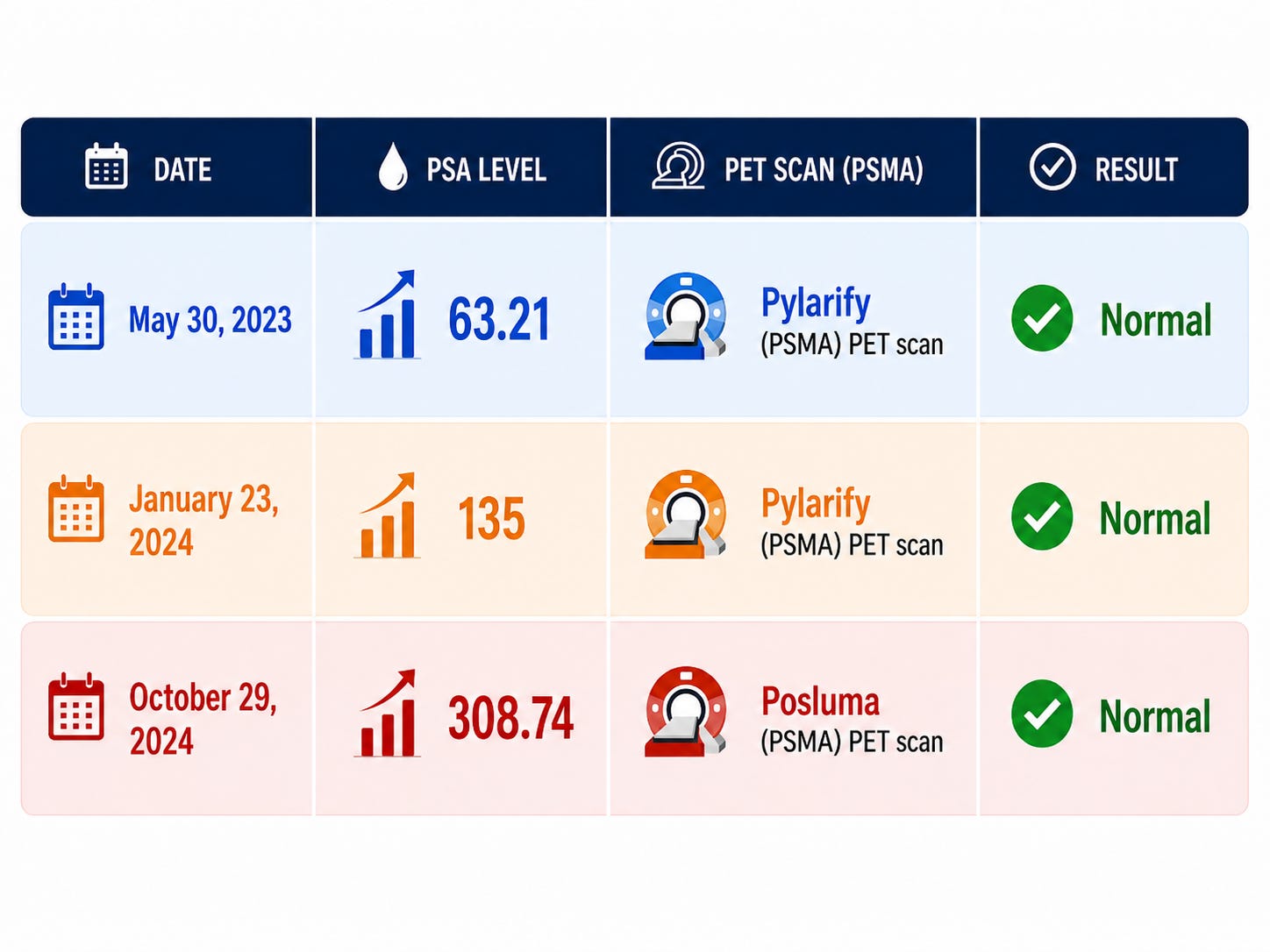
In February 2025, my PSA continued to rise to 369.14 ng/mL, and I made a desperate decision. On February 13, 2025, I began an experimental protocol of repurposed drugs and supplements:
Ivermectin 34 mg daily
Fenbendazole 500 mg twice daily
Methylene Blue 13 mg twice daily
By the end of April 2025, for the first time in years, my PSA had dropped by 53 points to 316.33 ng/mL.
I increased the Ivermectin to 136 mg daily while keeping the other medications the same. However, by July 2025, the PSA had risen 45 points to 361.69 ng/mL.
If we calculate the PSA doubling time (PSADT) from April 25, 2025 (PSA 316.33 ng/mL) through October 28, 2025 (PSA 395.90 ng/mL), my PSADT had slowed from an average of 9 months to 19 months while on those repurposed drugs.
But then I had a rapid increase in the PSADT starting October 28, 2025, which was associated with a period of poorly managed stress and the onset of persistent insomnia. I had also stopped the repurposed drugs for three and a half weeks before the blood draw.
March 3, 2026 PSA 640 ng/mL
June 5, 2026 PSA 762 ng/mL
Most recent PET scan
June 22, 2026 Illuccix (PSMA) PET scan: 9 metastatic deposits in the hilar (between the lungs) lymph nodes and 11 metastatic deposits in the bones, the majority 1 cm or less.
This disease is full of surprises, isn’t it? PSMA-avid disease was not detectable on three consecutive scans over a year and a half despite a rising PSA, but it is now detectable on the most recent scan.
I have to admit, the most recent PET scan results felt like a gut punch. But given a PSA of 760 ng/mL, it would be logical to expect to find something. After over eight years living with advanced prostate cancer, it finally showed up in my bones.
Thankfully, none of these metastases are symptomatic. I’m still going to the gym and working out with my usual intensity. The bone lesions are small, and the imaging did not show any that would put me at risk for a fracture.
So, after a week of feeling very blue and lots of introspection, I’ve come up with a new plan. Science would say I should go back on ADT with an androgen receptor pathway inhibitor (ARPI), like abiraterone or enzalutamide.
ADT monotherapy, or its equivalent, is no longer the standard of care.
But my quality of life is way more important than my quantity of life. After all, I’ve had eight years of, mostly, an incredible quality of life without following the standard of care.
The initial plan
My radiation oncologist, who knows me well, had suggested we go after the perihilar nodes with proton therapy, just like we did with the periaortic nodes in 2023.
He also said that should any of the bone mets become symptomatic, we could treat them with stereotactic body radiation therapy (SBRT), which is a highly precise, highly condensed ablative radiotherapy given over one to five sessions.
So, that was the initial plan. But the more I thought about it, the more I considered how far behind the eight ball I was now, given the number of bone mets. Once you move from nodal metastases to bone metastases in prostate cancer, your prognosis and overall survival decrease.
Not only that, radiation therapy generally works better in the setting of testosterone suppression, at least in hormone-sensitive disease. And that was the other question my radiation oncologist voiced. Is this still hormone-sensitive?
I’m 99% sure it is still hormone-sensitive. After all, I only received two 30-day depot injections of Trelstar, a luteinizing hormone-releasing hormone agonist (LHRHa), also known as a gonadotropin-releasing hormone agonist (GnRHa), back in 2018.
Historically, men with metastatic prostate cancer treated with continuous ADT alone developed castration-resistant disease after a median of about 18–24 months.
But the only way to know for sure if the disease is still castration-sensitive is to suppress my testosterone to castrate levels (< 50 ng/dL) and see what my PSA does. But how do we do that without causing the severe hot flashes, night sweats, and depressive symptoms I experienced in 2018?
Estradiol patches to the rescue
Thankfully, there is data from the PATCH trial showing that transdermal estradiol (tE2) is noninferior to ADT (LHRHa) with three-year metastasis-free survival and five-year overall survival for men with locally advanced prostate cancer.
In the metastatic setting, the STAMPEDE trial (embedded phase 2 randomized study) showed that transdermal estradiol plus an ARPI, compared with ADT (LHRHa) plus an ARPI, is equivalent with respect to short-term six-month PSA suppression.
And, importantly for me, the data from these trials showed that men on tE2 patches had a dramatic reduction in the incidence and severity of hot flashes, as well as less fatigue.
The PATCH study also showed several other benefits compared to ADT, which I’ll discuss in the next newsletter.
I presented this data to my radiation oncologist, who already knew about it. In fact, he’d already prescribed tE2 for a couple of his patients who were intolerant of ADT due to hot flashes, but hadn’t mentioned it to me because he thought I seemed dead set against any form of androgen suppression.
He recommended I undergo prophylactic low-dose radiation to my breast buds to help reduce the risk of gynecomastia, which is much more common when using tE2, instead of ADT, in men. I underwent 3 days in a row of breast bud radiation in preparation for starting the patches.
Two days later, I started using the tE2 patches. Following the induction protocol of the PATCH trial, I apply four 0.1mg/day patches twice a week for the first month, and then we’ll check testosterone and PSA levels. If my testosterone level is castrate (< 50 ng/dL), I can then reduce it to 3 patches twice a week.
The patches are circular, only an inch in diameter, and stick amazingly well. I followed the instructions to apply them to clean skin and hold my hand on them for about 30 seconds to “heat-seal” them to my body.
I’m on my third week of using the estradiol patches and haven’t had any fall off or come loose. Most importantly, I haven’t experienced any side effects except for some mild nipple sensitivity. No gynecomastia, hot flashes, night sweats, or fatigue.
But the real test will be when my testosterone level is < 50 ng/dL. When that happens, if my PSA drops, I’m still castrate-sensitive.
Unfortunately, my insurance wouldn’t cover the estradiol patches, so I’m using a discount coupon similar to those found on GoodRx, which is $250.00 for a month’s supply. I’ve asked my radiation oncologist to submit a letter of medical necessity, and I hope that works.
Repurposed drugs
What about the repurposed drugs?
I’ve decided to stop the repurposed drugs as they don’t seem to be helping. Whether the drugs caused the initial 53-point decline and the subsequent slowing in my PSADT can’t be proven. But for such an abrupt and unprecedented change in my PSA velocity to begin shortly after starting the drugs would have been an extraordinary coincidence.
Regardless, the disease has escalated despite being on those drugs for over a year. In addition, I think I might have developed a sensitivity to the ivermectin, as the day after taking it caused severe fatigue and dark thoughts.
Risk for castration-resistance
Finally, what about my other concern about starting and continuing androgen deprivation? Whether you undergo castration with conventional ADT or use tE2 patches, the treatment creates “evolutionary pressure” that favors resistant tumor cells and can induce mutations, resulting in castration-resistance.
Castration-resistant prostate cancer is more aggressive than castration-sensitive prostate cancer and requires more drugs to control it.
I have a plan for that, which involves a form of adaptive therapy, but that’s a topic for another newsletter. In the meantime, my n-of-1 experiment continues, and I have a couple of more weeks before I can show that I am, in fact, still castrate-sensitive.
All in all, another setback on this very long experience, but I’m remaining positive and continuing to buck the trend. My bucking the trend is about maintaining my quality of life for as long as I can.
A simple way to support this newsletter

If you find Prostate Cancer Secrets helpful, one of the best ways to support my work is to purchase my eBook, Should I Have My PSA Checked And What If It’s High?
I used to offer paid Substack subscriptions, but I stopped because of the requirements to collect and pay state sales taxes and VAT in foreign countries. Since then, I have made every post and newsletter free.
The time it takes for me to research and write these newsletters is significant and takes a lot of energy.
Why I created the free companion PSA Compass app
I came to understand that PSA screening is highly complicated and requires straightforward information for the men considering it. Too often, men have had PSA tests without first being told about the potential benefits, limitations, and risks of screening.
PSA testing can help find aggressive prostate cancer early, when it may still be curable, but the PSA is prostate-specific, not cancer-specific. An enlarged prostate, inflammation, infection, or other noncancerous conditions often cause an elevated level.
This lack of specificity has caused and continues to cause many men to undergo prostate biopsies that don’t need one. In addition, PSA screening has led to overdiagnosis, which is a very serious problem.
PSA testing identified many low-grade, slow-growing prostate cancers that might never have threatened a man’s health or shortened his life. In the past, this commonly led to many men who were automatically treated with surgery or radiation rather than being offered active surveillance.
Some were left with lifelong erectile dysfunction, urinary incontinence, or bowel problems from treatment they may never have needed.
I built the PSA Compass app as a companion to the eBook to help men understand these tradeoffs before deciding whether PSA screening is right for them. The app helps you understand:
The potential risks and benefits of PSA screening
The harms of overdiagnosis and overtreatment
False-positive PSA results
The incidence of complications related to surgery and radiation
How age, ethnicity, family history, genetic risk, and previous PSA results may affect the screening discussion with your doctor
How your personal priorities influence the decision to know or not know one’s PSA and next steps should you undergo screening
The eBook contains a link to the companion web app. PSA Compass generates a personalized summary of the user’s risk context, preferences, and questions to bring to a medical appointment for discussion of PSA screening.
No login is required, and the information entered into the app is not stored on servers. When you click off the web app, any information you entered is deleted.
The eBook picks up where most PSA advice stops
Most PSA discussions with patients are brief and usually centered on providers’ biases and opinions. Most men don’t receive enough information about PSA screening to make a truly informed decision.
And they rarely receive guidance on what might happen after the result comes back.
Should I Have My PSA Checked And What If It’s High? explains the modern approach to prostate cancer screening and early detection, including:
How to talk about an elevated PSA with your provider in the proper context of health issues and risk factors
Why your PSA should be repeated before further testing
Noncancerous causes of a high PSA
PSA density and other ways to help assess risk
Why multiparametric MRI has become a high-priority before undergoing a biopsy
How and when blood or urine biomarkers may provide helpful additional information
How prostate cancer risk calculators help estimate your personal probability of finding aggressive or clinically significant prostate cancer
Differences between transrectal, transperineal, and MRI-targeted prostate biopsies
How to understand Gleason scores, Grade Groups, and other findings in a pathology report
What happens after a negative biopsy
When active surveillance may be appropriate
How to manage the anxiety of testing, waiting, imaging, and biopsy results
The goal of modern screening is to identify cancers that could become dangerous while reducing unnecessary biopsies, overdiagnosis, and treatment of cancers unlikely to cause harm. And this goal requires that men and their doctors receive the right information to make decisions.
Written in plain English and based on the 2026 AUA and NCCN guidelines, the eBook includes questions to bring to your healthcare provider at the end of every chapter. It also includes direct access to the free PSA Compass companion app, so readers can explore the screening decision interactively and prepare for a more informed discussion with their doctor.
Available on Amazon for $6.99:
https://www.amazon.com/Should-Have-My-PSA-Checked-ebook/dp/B0H9B95HWZ/
In the next newsletter, I’ll provide more information from clinical trials on using estradiol patches off-label for men with prostate cancer. One study showed that men on tE2 patches didn’t experience fatigue because they were not experiencing sleep-depriving hot flashes.
Until then, I wish you all good health and much love,
Keith
Hi Keith,
I hope the tE2 does what tE2 has been doing for Canadians and EU PCa patients to reduce testosterone for many years. In this country, thank big pharma, urologists, the AMA and hospital lawyers for settling the malpractice lawsuit against Abbot Labs by removing OTC tE2 from pharmacy shelves and making ADT drugs the only game in town with prescription access only from urology practices.
I'm sure you know that you can acquire tE2 gel and patches OTC in Mexico, Thailand and the EU. It is inexpensive and why countries with national healthcare have been using tE2 for ADT treatment. It is too cheap for pharma to make extraordinary profits protected by a patent.
When my BF could not tolerate injected ADT, he tried the repurposed drugs and supplements for a year and a half. He had the same Gleason and other features plus perineural invasion. Was classified as having a highly aggressive PC with numerous Mets to bone and lymph nodes. After scans showed some spread, he decided to try Orgovyx and Nubeqa. The only symptom is mild hot flashes which have been very tolerable. No fatigue. No pain. He says he feels fantastic! PSA dropped from 276 to .4 in 6 months and is still dropping. The beauty of Orgovyx is that it is a daily pill and you can stop if the side effects are too much. 3 months after starting ADT drugs his scan showed an overall decrease in lesions of 70-90%. I do think the repurposed drugs are acting synergistically with the ADT. Alkaline phosphatase 61 and LDH is 119, and CRP is .5. All other bloodwork is normal or very close to normal. We are looking forward to the next scan in October. Best wishes and thanks for sharing.