

I use the term ‘PSAnxiety’ because I was noticing that every time it came around, the time for me to recheck my PSA, I would start feeling this low-grade anxiousness creeping in. As the time got closer to the blood draw and especially when I was about to get the results, the anxiousness progressed from low-grade to high-grade.
I could feel my heart racing as I was opening the portal to get my results. If the PSA was worse than I thought it should be, I felt this “monkey on my back,’ literally increasing the heaviness and darkness of all my thoughts.
Individual perception of stress
I teach a best-selling course on Udemy.com about the impact that stress has on your health and ways to reduce the stress response. Despite teaching and practicing these concepts, I’d still develop some form of stress response around my PSA results.
That shows you how powerful the mind can be when you are in a situation that you perceive as incredibly stressful. This perception of incredible stress relates to the idea that my PSA results may lead to a cascade of events that can negatively impact my quality of life.
The keyword here is “perceive,” because it’s always the interpretation of an event that triggers a stress or relaxation response. Perception varies for all of us, depending on our baseline character traits, life experiences, sense of humor, and whether we’ve taken steps to learn to manage our perceptions optimally in stressful situations.
In over ten years of practicing mindfulness, I’ve found that maintaining awareness of the present moment can sometimes magically dilute the trauma of seeing a very high PSA level. When you maintain awareness of the present moment, you keep the power of your mind and body mostly in the present, rather than in the past or future, where anxious thoughts dwell on things that have happened or may never happen.
And when you do that, your mind has less power over you when it comes to catastrophizing.
Meditation
In addition, I have more than ten years of experience with various forms of meditation, ranging from simply being aware of nature as I walk to escaping into the blissful experience of a full-blown relaxation response after listening to a peaceful guided meditation augmented with brainwave entrainment tracks.
Brainwave entrainment tracks are something I teach about in my class and have used for many years. There are music tracks that contain an embedded repetitive stimulus called isochronic tones or binaural beats (my preference), which can literally walk your predominantly fast (anxious) brainwaves down into more predominance of slower (peaceful) brainwaves. It’s one way I “cheat” in meditation:-))
Brainwave Entrainment as a Meditation Tool
If you pay attention long enough to any type of repetitive stimulus, your brain may start to entrain to the frequency of that stimulus. This repetitive stimulus may be in the form of sound, light, or vibration.
Modern brainwave entrainment technology uses binaural beats and isochronic tones set to a specific frequency. These beats and tones, when embedded in meditation soundtracks, are perceived by the brain as a repetitive stimulus. Different frequencies are used depending on the meditation track’s goal.
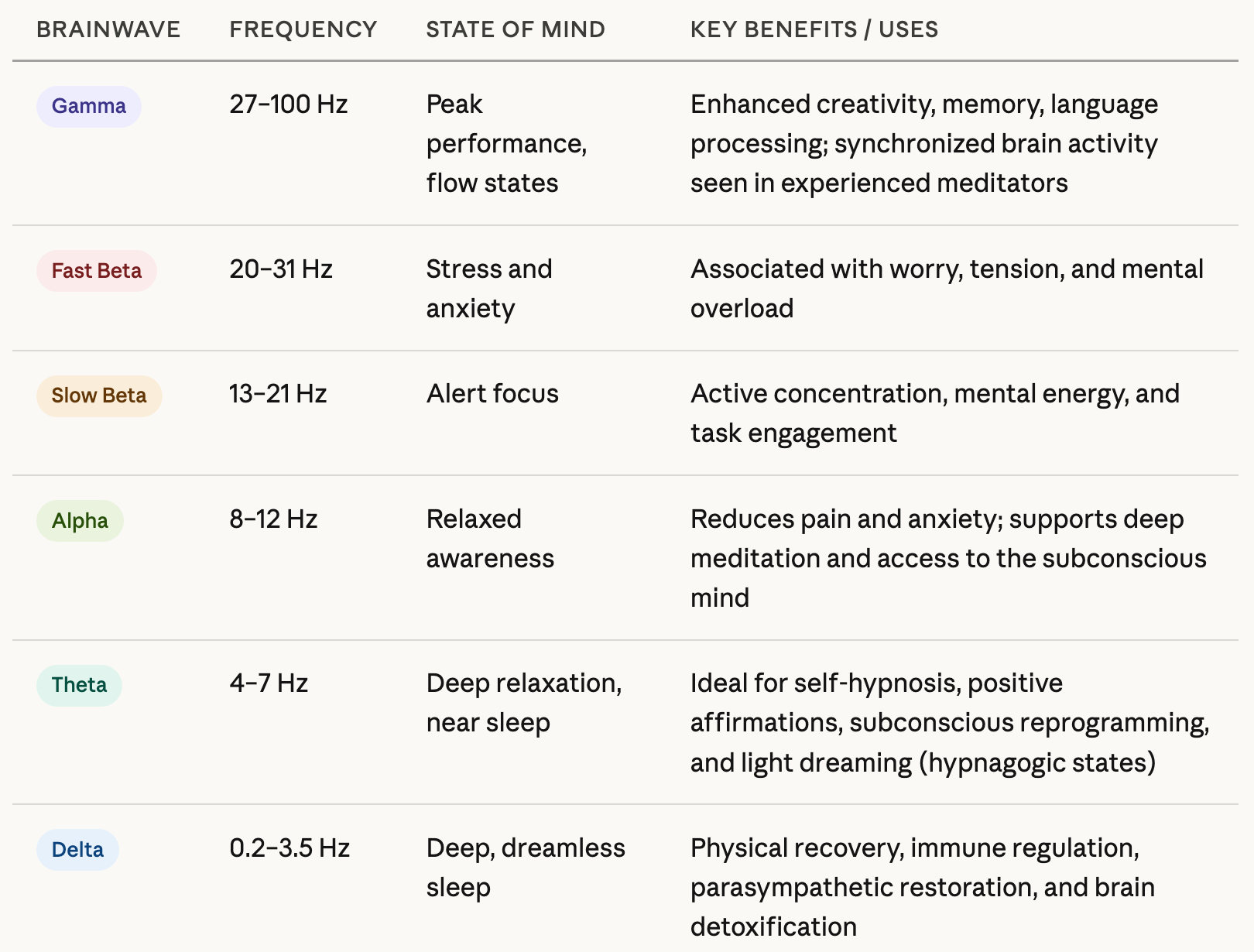
It’s common to use frequencies that entrain brainwaves into the alpha and theta ranges to help someone relax or deepen meditation. A delta frequency in the form of auditory binaural beats or isochronic tones may be used to help someone fall asleep.
Binaural Beats
One type of auditory stimulus used in modern brainwave entrainment is binaural beats. Binaural beats use two tones of slightly different frequencies, played in the right and left ears, resulting in the brain perceiving a single tone at the difference between the two.
For example, if you want to use binaural beats to entrain someone into the alpha range (8–12 Hz), play one tone in one ear at 108 Hz and another tone in another ear at 100 Hz, and the brain will perceive it as the difference between the two, which is 8 Hz. Since this 8 Hz is played as a repetitive stimulus, the brain will start to entrain to this frequency, and you’ll likely develop a predominance of alpha brainwaves.
Headphones or earbuds are necessary for binaural beats to be effective because each ear has to receive a different tone. In the brainwave entrainment industry, binaural beats are often embedded in music tracks.
Some people don’t hear the repetitive stimulus of binaural beats, but your brain perceives it anyway. Binaural beats are well-studied in science and the results of using them are published in peer-reviewed journals.
If you’d like to read some of these studies, click on this link to PubMed.
Here is a link to some meditation tracks with binaural beats for you to experiment with.
https://insighttimer.com/meditation-topics/binauralbeats
Stressing about lab results
What is happening when I feel stressed out by a lab value? Over time, in my over eight-year journey with advanced prostate cancer, I learned to associate a “high” PSA with bad news and bad experiences. But, depending on where you are in your journey, “high” is relative.
If a man is getting screened for prostate cancer for the first time with a PSA lab test, a “high” to him might mean greater than 4 ng/dL. For another man who has already been diagnosed with advanced prostate cancer, it might be seeing his PSA rise from 0.9 to 1.8 ng/dL over three months because that represents to him a rapid doubling time, indicating a high risk for developing metastases.
So you can see how everyone’s perception can be different. But in all honesty, no matter the situation you are in or what the test results are, you have the ability to buffer or override the stress response that comes with it.
The really practiced man can even head off a stress response entirely, but he is the exception to the rule.
Regardless of the circumstances you are facing, the goal is to maintain a balance between the stress and relaxation responses. And the closer you get to that relaxation response, the better you feel and the less something negatively affects your physiology.
What stress does to your body
Frequent and prolonged stress responses, in which adrenaline remains chronically elevated, result in a breakdown of our bodies’ systems, including suppression of our immune response. And for men whose goal is to overcome cancer, go into remission, or maintain slow tumor growth, a suppressed immune system is not something we want to have.
And then there are all the other stress-associated conditions that can occur in our minds and bodies, including full-blown anxiety, depression, and impaired sleep. This list has the potential to be quite long and quite detrimental to our mental and physical well-being.
An uncontrolled stress response can hijack your normally rational mind and cause your stress hormones to surge.
The good news is that we can take steps to prevent this cascade of events that leads to feeling completely stressed out, or, at the very least, minimize this stress response so we recover more quickly.
To be honest, it is the rare man who doesn’t feel stressed out from time to time. It’s called being human.
So what exactly can we do to make sure you don’t have to white-knuckle it through those periods of testing, waiting, and getting our test results? Well, a lot actually.
The key is to find what works for you and then do it regularly. I’m going to give you several options to experiment with and see what resonates most with you. Because if you are practicing a stress reduction technique that you don’t resonate with, it probably won’t work.
Using your breath as an anchor
I like to start by reminding you that there is one practice we all have at our disposal and can do for free - breathing. But we need to breathe in a way that triggers our relaxation response.
If you’ll notice, the next time you feel stressed out, you are likely breathing in small, shallow, but frequent breaths. Odds are, when that’s not at the end of a run or a workout, it’s from a stress response.
Why is your breathing, and specifically, the right kind of breathing, so helpful? A slow and controlled breath, especially diaphragmatic breathing, has the potential to stimulate a very large nerve in your body, called the vagus nerve.
Diaphragmatic breathing
Diaphragmatic breathing involves breathing so deeply that you incorporate your diaphragm, the broad, flat muscle at the base of your lungs. When you breathe deeply enough that your abdomen pooches out and your chest doesn’t rise, you are performing a diaphragmatic, or belly breath.
Watch how a baby breathes, and you’ll see what I mean. You breathed like this as a baby, and you can learn to do it again if you’ve forgotten how.
Shallow chest breathing is something we’ve learned as part of the stress response, and for some people who are almost constantly stressed, this is normal for them.
The vagus nerve, also known as cranial nerve X (ten), is the main nerve of the parasympathetic nervous system that innervates your heart, lungs, and entire gastrointestinal tract, among other body parts.
Your parasympathetic nervous system is part of your nervous system that regulates your body’s rest-and-digest functions and helps facilitate your relaxation response. Most of us know what a relaxation sensation response feels like.
Remember that time you were relaxing on a beach while on vacation, or when you were drifting in and out of sleep in that hammock in your backyard on a quiet, cool, and sunny day? Now we just have to learn to recreate that response whenever we choose, even under less-than-optimal circumstances.
Some of us are better at this than others, but we can all learn to do it with certain techniques and tools. The more you practice, the better you get at doing this.
It’s like learning to play an instrument really well, practicing to become an All-State point guard or a division-winning quarterback. It’s doable with the right tools and mindset.
The mindset I’m talking about is ‘believing you can’ and giving yourself permission to practice.
Relaxation response
It turns out that deep relaxation is very good for you. When you are relaxed, your body maximizes its capacity to heal, regenerate, and repair itself. Science shows that the relaxation response significantly reduces inflammation and optimizes your ability to metabolize glucose, a primary fuel for your cells.
Uncontrolled inflammation is at the root of most chronic diseases and plays a large role in the progression of cancer. Stress reduction, including the relaxation response, helps reduce this uncontrolled inflammation.
Another important function of the relaxation response is to dampen excessive oxidative stress that constantly occurs in our bodies. Oxidative stress is a normal byproduct of turning food into energy, is further fueled by uncontrolled emotional stress, and can eventually overwhelm body systems by creating the equivalent of body rust.
Rust is never a good thing for any type of system.
In addition to optimizing stress management through the relaxation response, we can dampen oxidative stress by eating colorful foods rich in natural antioxidants, getting adequate sleep, exercising regularly, and avoiding environmental toxins. And when you are relaxed, it’s easier to do all of those things.
Breathing your way out of the stress response
This sounds too simple to be effective, but it can be very helpful when done properly.
Your autonomic nervous system has two modes: sympathetic, the fight-flight response, and parasympathetic, the rest and digest response. Slow, controlled breathing directly activates the parasympathetic system by stimulating the vagus nerve.
In addition to diaphragmatic breathing, you can perform a certain number count to help adjust the amount of breath in and out. Counting numbers helps you better control and slow your breathing, which is integral to stimulating your vagus nerve.
Box breathing is used by Navy SEALs to stay calm. Inhale for a count of four. Hold for four seconds. Exhale for four seconds. Hold for four seconds. That’s one box. Do four to six sets of box breathing and notice what happens to your heart rate and the tension in your body-mind.
4-7-8 breathing goes a step further. Inhale through your nose for four counts, hold your breath for seven, and then exhale slowly through your mouth for eight. The long exhale is the key, as that gives your vagus nerve a stronger stimulus to activate your parasympathetic response. Dr. Andrew Weil popularized this technique, and it can be very effective if you resonate with it.
Either technique takes under three minutes. You can do them in your car before you walk into the lab, in the waiting room, or at 2 am when you feel like you can’t control your monkey mind and are thinking worst-case scenario thoughts.
Mindfulness during the waiting period
Mindfulness isn’t about emptying your mind or achieving some blissful state. It’s about learning to observe your thoughts without being dragged down by them.
When you’re waiting on PSA results, your mind tends to jump forward into a future that hasn’t happened yet and starts reacting to scenarios that may never occur.
Mindfulness is the practice of noticing when that’s happening and coming back to the now.
Ground yourself in your body
You can also do a simple exercise to ground you in your body. Sit quietly and name five things you can see, four things you can physically feel, three things you can hear, two things you can smell, and one thing you can taste.
It almost sounds childish, but acting like a child can be wonderful.
This technique holds your attention in the present moment through your senses, and anxiety has a hard time existing there. And your senses only work in the now.
Another technique that can reduce stress is a body scan, which takes only about 10 minutes. Lie down in a comfortable position, close your eyes, and slowly move your attention from the top of your head to the soles of your feet.
When you perform a body scan, you’re not trying to fix anything. You’re just noticing any sensations such as tension, warmth, tightness, or relaxation. This technique activates the parasympathetic nervous system and interrupts your monkey mind, helping to stop anxious thinking.
If you already have a meditation practice, this is the time to double down on it. If you don’t, even five minutes daily of focused breath awareness during the waiting period can help you feel better.
Favorite technique
Here is one of my favorite techniques. Go out into the back yard, preferably in your bare feet. Stand in one place and close your eyes. Focus on how your bare feet feel on the earth. Feel the heaviness of your body resting on the earth.
Feel the sun and wind on your skin. Take a deep breath, close your eyes, then imagine roots like a tree’s, growing deep into the earth.
Now imagine this warm, honey-like substance flowing up the roots into your body, slowly filling it with this warm, nurturing substance. Now let this warm, nurturing substance reach the top of your head, exiting there and slowly flowing down the sides of your body.
Now imagine a bright white healing light shooting down from the heavens or the cosmos into the top of your head, filling your body with it. You are now metaphorically connected to heaven and earth.
Here is a version of that technique, available as a guided meditation I created. The background music of this guided meditation contains binaural beats in the alpha brainwave range.
Reframing - changing the story your monkey mind is telling you
Your mind loves to tell stories and attempt to predict the future. Your mind thinks that if you plan for every worst-case scenario, you’ll have more control over the situation when it happens. This is a stress response all dressed up as an illusion.
Reframing this stressful story is a way to get your mind to offer a less stressful and usually more accurate one. This technique is not about practicing toxic positivity, where you’re pretending everything is fine.
You’re simply attempting to reframe your distorted and stressful thinking.
When I was waiting for my prostate biopsy results, my mind kept jumping to the worst possible scenario. So, I practiced reframing the story as ‘I don’t yet have the information to know what’s true.’
Reacting to a story I made up is way more stressful than responding to a fact.
Keep the following in mind when reframing: A high PSA is not a diagnosis. It’s simply a sign that something needs further evaluation. Many men with elevated PSAs do not have cancer. In fact, the PSA test has a high rate of false positives.
Multiple studies show that first-time prostate biopsies are normal in 70-75% of men. Inflammation, infection, an enlarged prostate, or recent trauma to the prostate can all cause an elevated PSA.
Even if cancer is found, the vast majority of prostate cancers are slow-growing and highly treatable, especially when caught at an early or intermediate stage.
For many men, knowing is better than not knowing. Having the result of a prostate biopsy lets you make informed decisions. Uncertainty is its own kind of suffering, and obtaining the information may end that self-induced suffering.
Remember that you have handled hard things in your life before, and your track record for surviving difficult experiences is probably pretty solid.
Practical daily anchors
During the waiting period, adding some type of structure to your daily routine matters more than you think. When anxiety is high, your brain craves predictability, and a daily routine is a form of self-regulation.
Keep exercising. I gauge my health by my performance at the gym, and if there is one thing that comes close to a panacea, it is exercise. Exercise reduces stress, boosts those feel-good endorphins, and gives you real-time evidence that your body is functioning okay.
Even a thirty-minute walk does wonders for how you feel.
Get out in nature daily and go to places that make you feel good. For me, it is the Jacksonville Arboretum & Botanical Gardens because I love trees and plants. Being in nature helps trigger my relaxation response.
Stay off the search engines and large language models after dark. There is no productive PSA research conducted at midnight, because you’re probably not going to find reassuring information at 11 pm. You’re going to find the worst-case statistics and spend the next three hours spiraling.
Set a hard cutoff for daily medical research, and stick to it.
Tell someone what you’re going through. Not to burden them, but because isolating yourself makes anxiety worse. My husband, Mike, knew everything that was going on with me during those weeks of waiting, and that comforted me more than I can explain.
You don’t have to manage this alone. For some men, that may mean joining a men’s prostate cancer support group associated with ANCAN or ASPI.
If you’re spiritual or religious, lean into that practice. For some, nature represents the Divine. So, attend church, pray, meditate, contemplate, go forest bathing, or whatever your version of that looks like.
There is substantial research showing that spiritual practices reduce anxiety and improve health outcomes in people facing serious illness. I have experienced this and know it creates a positive shift in my body and mind.
When anxiety needs more than self-help tools
Almost everything described here is evidence-based and usually effective for most people during waiting periods. But keep in mind that some anxiety goes beyond what breathing exercises and reframing can help with.
If you find yourself unable to sleep for more than a few nights, unable to function at work, withdrawing from people you love, or having thoughts of harming yourself, that is much more than PSAnxiety.
You could be experiencing a mental health crisis that deserves the same attention you’d give a physical symptom.
Talk to your doctor. Ask for a referral to a therapist who works with patients facing medical illness. Reaching out to someone who can help you is not a weakness.
I know from personal experience how hard the waiting period is. But you can move through it with more steadiness than you might think, and I hope the tools in this article can help you do that.
Every action you take to soothe your mind is a form of self-love, and we all need self-love.
May you find the peace you are seeking.
Much love,
Keith
I have long used the technique of manifesting (a type of reframing) to visualize a positive outcome, trying to avoid a stress reaction in the first place. I had my most recent PSA test on Monday and visualized a positive, undetectable result as I was walking away from the lab. For me, that works wonders. (And yes, it was the result I believed. 😀)
As always, Keith your experience, intuition and compassion unite the thoughtful words in this article, I always try to Let Go and Let God. Blessings to you!